Pub Entertainment Ideas: Darts, Pool, Cards and More
July 31, 2026
The best casino night party ideas are not about filling a room with playing-card decorations. A successful evening needs a clear flow: guests arrive, understand how the games work, move easily between tables, grab food and drinks without interrupting play, and have enough variety to stay engaged.
The strongest casino theme party ideas start with planning rather than shopping. Choose the atmosphere first, match the games to the size of the group, and build the decorations, dress code and menu around the same concept. Three well-organized gaming areas will usually work better than a crowded room full of activities nobody quite knows how to use.
Decide what kind of atmosphere you want before choosing games or decorations. The concept affects everything from lighting and table design to invitations and clothing.
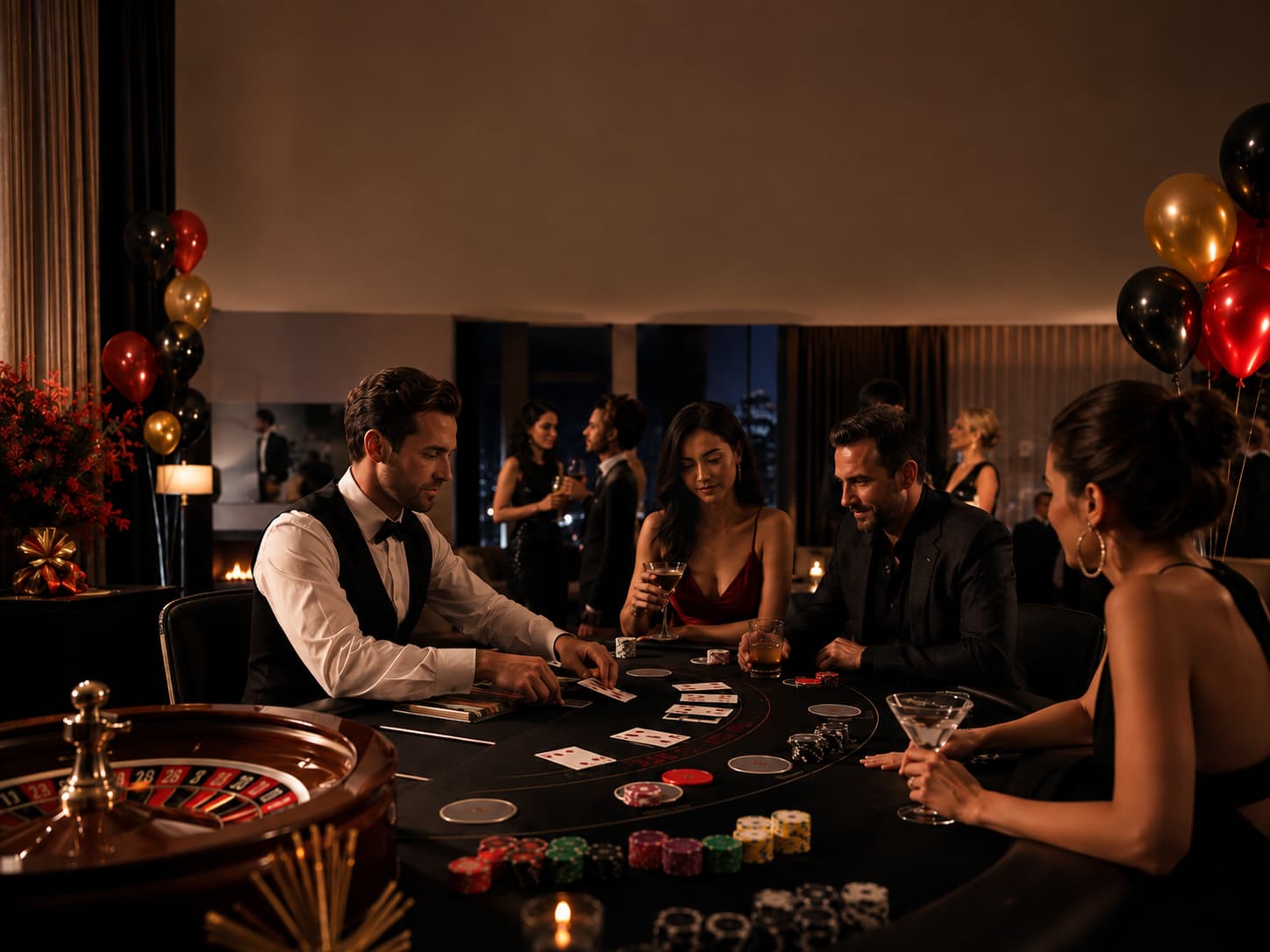
This is the easiest style to recognize. Red, black and gold work naturally with cards, dice, roulette and casino chips. Add bold signage, a photo area and a slightly theatrical atmosphere without trying to reproduce an actual casino floor.
It works especially well for birthdays, group celebrations and casual parties where guests should understand the theme immediately.
For a more formal event, use a restrained palette, darker table linens, subtle metallic details and cocktail attire. Poker, blackjack and roulette fit this style better than brightly colored novelty props.
The result should feel closer to an evening reception than a costume party.
A 1920s-inspired casino party has a clear visual direction: black, gold, art-deco patterns, vintage-style signage and formal outfits.
This concept works best when the idea carries through the invitations, music and clothing instead of appearing only around the gaming tables.
A smaller gathering does not need rented tables or professional equipment. A dining table can handle poker or blackjack, while a compact roulette set or another game can create a second station.
At home, comfort and movement matter more than visual scale. Leave enough room for people to stand, watch and change games without crowding the players.
Start with the guest count and usable floor area.
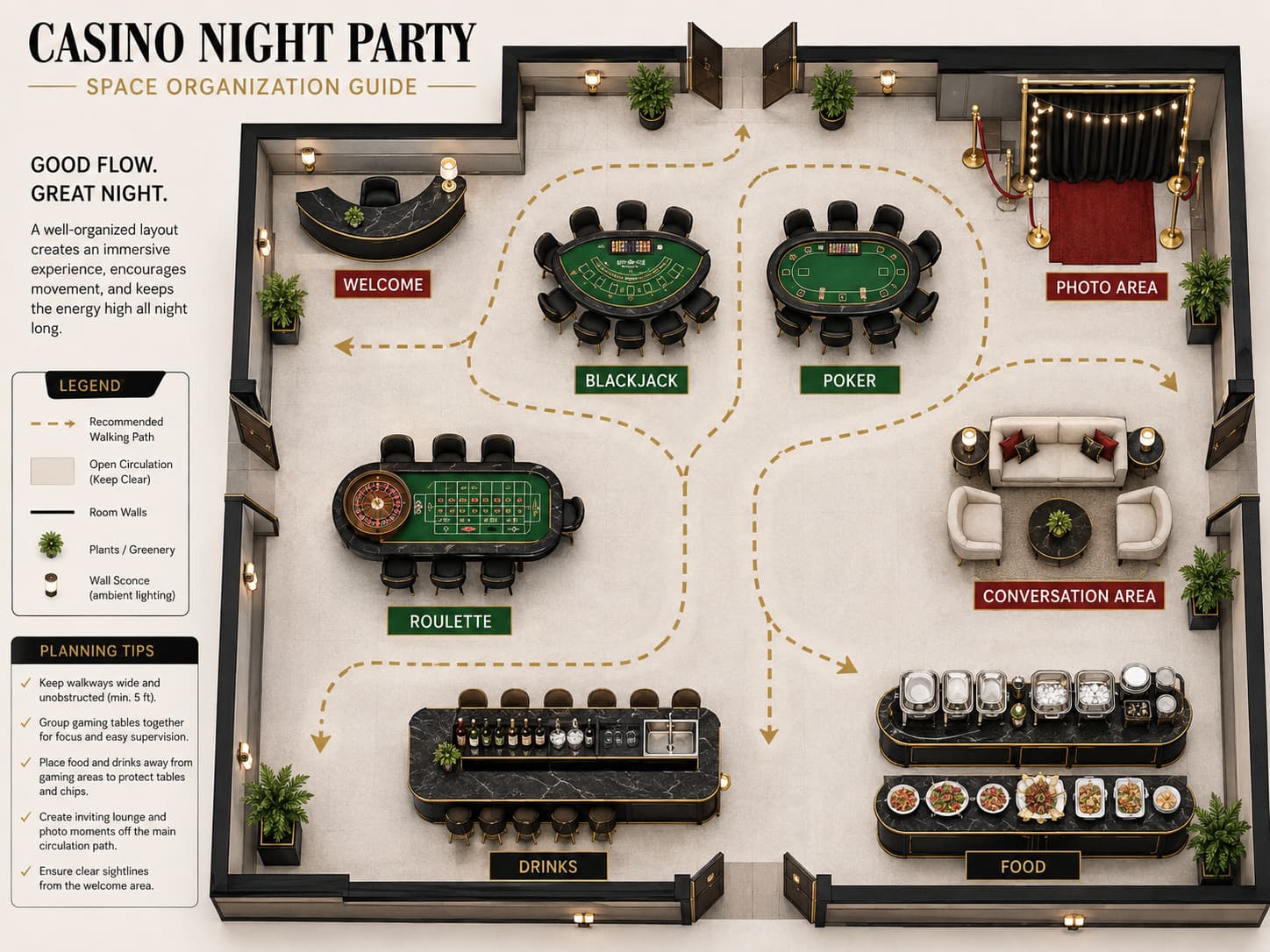
Every gaming station needs room for players, spectators and people moving behind the chairs. Food and drinks should have their own area so guests are not setting plates beside cards, chips and equipment.
A practical layout can include an entrance or welcome point, gaming stations, a drinks area, a separate food station and open space for conversation. A photo area is optional rather than essential.
For a small gathering, one or two games may be enough. A medium-size event benefits from several stations so guests can rotate instead of waiting for a seat.
| Guests | Planning example |
|---|---|
| 6–10 | 1–2 main games |
| 10–20 | 2–3 different gaming stations |
| 20+ | Multiple stations with easy rotation |
Treat this as a starting point rather than a fixed ratio. A poker table occupied by the same players for an hour behaves very differently from a blackjack station where people can join and leave quickly.
The useful question is not how many games can fit into the room. It is how easily guests can understand them, join a round and move on.
Blackjack works well in a social setting because several guests can participate at once and players can change without waiting for a long tournament to finish.
If part of the group is unfamiliar with the game, explain the basic sequence before the first round instead of assuming everyone already knows it.
Roulette creates a strong visual focal point and allows guests to participate without committing to a long session. That makes it useful when people are moving between several stations.
A party does not require a full-size professional table. A compact setup can provide the same basic role when the goal is atmosphere and casual play.
Poker is a good choice for groups that already enjoy card games, but the format matters.
A tournament keeps the same people seated for longer periods. For a social event, shorter casual rounds are often more convenient because guests can rotate between poker and other activities.
Craps can add variety to a larger setup, particularly when someone is available to explain the game. For a smaller gathering, blackjack, poker and roulette are generally easier to organize.
Decorations work best when a few repeated visual elements connect the whole room.
A simple palette can do most of the work:
Cards, chips and dice are obvious decorative elements, but they should support the setup rather than overwhelm it. One large backdrop or photo area usually has more impact than dozens of small themed objects scattered around the room.
Lighting matters as well. Softer light around the room helps create atmosphere, while the gaming tables themselves should remain bright enough for players to see cards and chips comfortably.
If several games are running at once, simple table signs can also tell guests what is being played and make the room easier to navigate.
The menu should reflect how guests will actually spend the evening.
People will be standing, moving between stations and frequently holding cards, chips or drinks. A formal plated meal can interrupt that flow.
Better options include finger foods, small sandwiches or sliders, skewers, bite-size appetizers, individual desserts and grazing boards. The important point is not the specific recipe but whether it can be eaten comfortably without requiring everyone to sit down.
Place the food away from the gaming tables. A separate station reduces congestion and keeps plates and spills away from cards and equipment.
It also lets guests take a break when they want rather than stopping the entire evening for a meal.
Drinks can reinforce the theme without requiring an elaborate cocktail menu.
One or two signature cocktails can sit alongside beer, wine, mocktails, sparkling water and other non-alcoholic options.
Match the presentation to the concept. An elegant Monte Carlo evening calls for a different style from a playful Las Vegas birthday.
A clear dress code tells guests what kind of evening to expect before they arrive.
For a general casino theme, casino chic or cocktail attire is easy to follow. Guests can dress up without needing costumes.
Other options include black tie for a formal setting, vintage clothing for a Gatsby concept, Vegas-style evening wear for a brighter party or smart casual clothing for a relaxed home gathering.
The outfit should follow the chosen style rather than becoming a separate gimmick. State the dress code clearly in the invitation so nobody has to guess how formal the event will be.
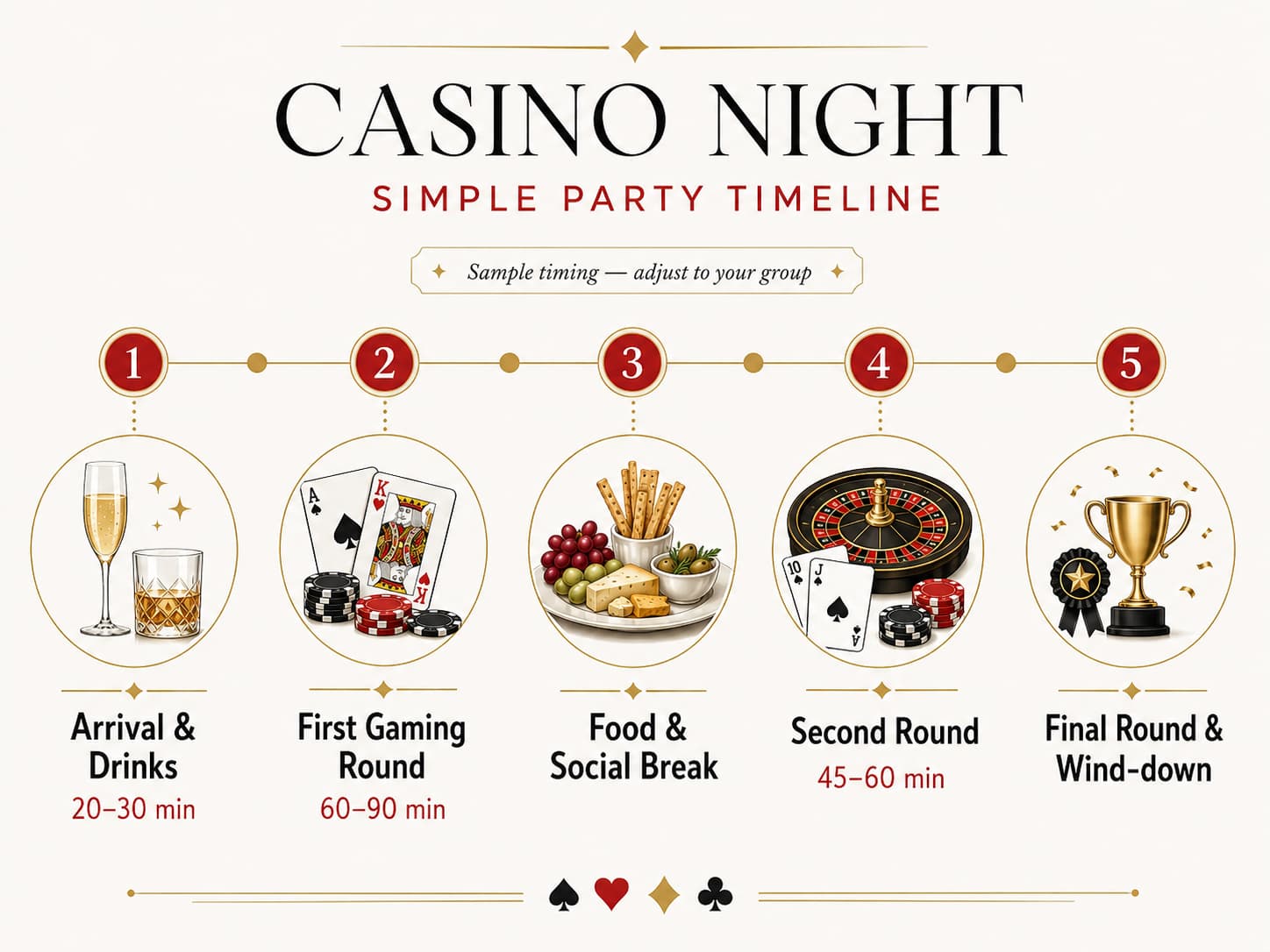
The night feels much more organized when there is a basic sequence without forcing guests through a rigid timetable.
Give everyone time to arrive, get a drink and understand how the games work. If you are using play money or chips, distribute the starting amount at this stage.
Open the main stations and let guests move between them. This is usually the most active part of the evening.
Give people a natural opportunity to step away from the tables, eat and talk. Every game does not have to stop simultaneously.
Return to the games, change tables or introduce an activity that was not used during the first part of the evening.
If there is a competition, establish a clear finishing point and explain how the result will be determined.
Leave some time after the final round for drinks, conversation and photos. The party does not have to end the moment the games do.
These timings are planning examples, not requirements. The useful part is the sequence: arrival, active play, a break, another round and a recognizable finish.
A simple system is easier for guests to understand.
Before the event, decide:
Use the same starting conditions for everyone and explain the system before play begins. Changing the mechanics halfway through the evening usually creates unnecessary confusion.
For a purely themed game, chips can simply act as a scoring system. If you want a competitive ending, they can also determine the order in which guests choose symbolic prizes.
Real-money online gaming is a separate format from the play-chip system used at the physical party tables, so there is no reason to make the two balances interact.
New Jersey also uses casino night as a defined format within its legalized games-of-chance rules. The state's Legalized Games of Chance Control Commission describes regulated casino-night events under the Raffle Licensing Law: players use imitation money in authorized games, and that imitation money may be redeemed for merchandise prizes or raffle tickets rather than cash.
That regulated format is especially relevant to organizations planning fundraising events. The state also sets requirements for licensing, equipment providers and the conduct of those games.
If the event is being organized as a fundraiser or other regulated game-of-chance event in New Jersey, its structure should be checked against the current LGCCC requirements rather than relying on ordinary party-planning conventions.
Before the event, confirm that you have:
You do not need dozens of separate ideas to create a convincing evening. A consistent theme, a few well-chosen games and a clear plan for how guests move through the event will usually produce a better result than an overloaded setup.
For a small group, one or two may be enough. Larger parties benefit from several stations so guests can move between activities without waiting. The key factor is how many people can participate in each game at the same time.
Blackjack and roulette are convenient because guests can join and leave relatively quickly. Casual poker also works well, particularly when the group already knows the basic rules.
Red, black and gold are the most recognizable combination. Black and gold create a more formal look, while green felt works naturally around card and gaming tables.
Cocktail attire or casino chic fits most events. Black tie suits a formal concept, while Gatsby-inspired clothing or Vegas-style outfits work when the theme is more specific.
There is no universal duration. Several hours is usually enough to accommodate arrivals, multiple rounds of games, food and a final activity. The schedule should follow the size and style of the group rather than a fixed formula.


 Pub Entertainment Ideas: Darts, Pool, Cards and More
July 31, 2026
Pub Entertainment Ideas: Darts, Pool, Cards and More
July 31, 2026
 Hoboken vs Jersey City Nightlife: Which Is Better?
July 29, 2026
Hoboken vs Jersey City Nightlife: Which Is Better?
July 29, 2026
 What Is a Pub Crawl? How It Works, Types and Tips
July 28, 2026
What Is a Pub Crawl? How It Works, Types and Tips
July 28, 2026
